

Seeing Shapes: A Recent Design Project
At dbase studio, every project is an experiment. A chance to explore how art, design, and space interact. Every so often, though, a piece feels more personal than the rest. One that connects past work, quiet inspirations, and creative instincts in a way that feels intentional.
This latest installation was one of those moments. It has been years in the making, not just in terms of skill and technique, but in understanding why I am drawn to certain shapes, forms, and spatial relationships. What began as abstract dreams slowly evolved into a visual language I could finally bring to life on the wall.
Throughout this post, I have included photos showing how the piece evolved, from early sketches and models to the finished installation of a recent design project.
Where It Started
As far back as I can remember, I had strange dreams about huge, overwhelming shapes. They collided, stacked, and competed for space, feeling massive and impossible to fully comprehend.
For years, I did not think much of them. But when I started creating art, those shapes resurfaced. I tried sketching them, but translating that feeling onto paper was frustrating. I could never quite capture the sense of awe they gave me, and it became a puzzle I felt compelled to solve
Eventually, I found myself drawn to photographing buildings. I had always appreciated brutalist architecture, but once I began taking photos, I realised that was where the awe came from. It was the same feeling I had experienced in those dreams. Drawing from my photographs helped me understand the shapes more clearly. After months of sketching, the forms became second nature, and I no longer needed references. I could finally recreate that sense of scale and weight from memory.
By this point, my paintings had grown in size, and I was commissioned to redesign the exterior of Pop Brixton. It felt like the perfect opportunity to test this evolving process. I began deconstructing architectural forms and reimagining them through my own lens, using the surrounding buildings as direct inspiration and letting the environment guide the design.
After a year of working almost exclusively in black and white, I felt ready to reintroduce colour. I started layering shapes, and learning more about colour theory, particularly additive colour. That period of exploration gave the work a new energy and pushed it in a direction I had not anticipated.

For this latest installation, I wanted to work in a completely different way. Normally, I design directly over photographs of the site, but the space was so confined that every wide-angle image distorted the proportions. Instead, I built a small physical model of the space and imagined myself as a small object inside it.
That approach only got me so far. Frustrated, I dismantled the model and laid it flat. Seeing the painted shapes this way revealed an entirely new perspective, and that moment changed everything. I suddenly understood how to create a sense of scale and depth within such a limited space.
When I reassembled the model, I was no longer viewing it from the inside. I was observing it from a distance, and that shift completely changed how I approached the piece.
flat out model box model box close up
The brief I set myself was to create a space that transitioned revellers from the outside world into the interior of the club. I wanted the work to act as a threshold, something that subtly shifted people’s mindset as they moved through it.
Rather than treating the install as a standalone artwork, the aim was to extend the club’s branding into a physical experience. Something that people did not just see, but felt as they passed through the space. Perspective, scale, and movement became key tools in achieving that. The piece needed to pull people in, guide them forward, and prepare them for what waited on the other side.
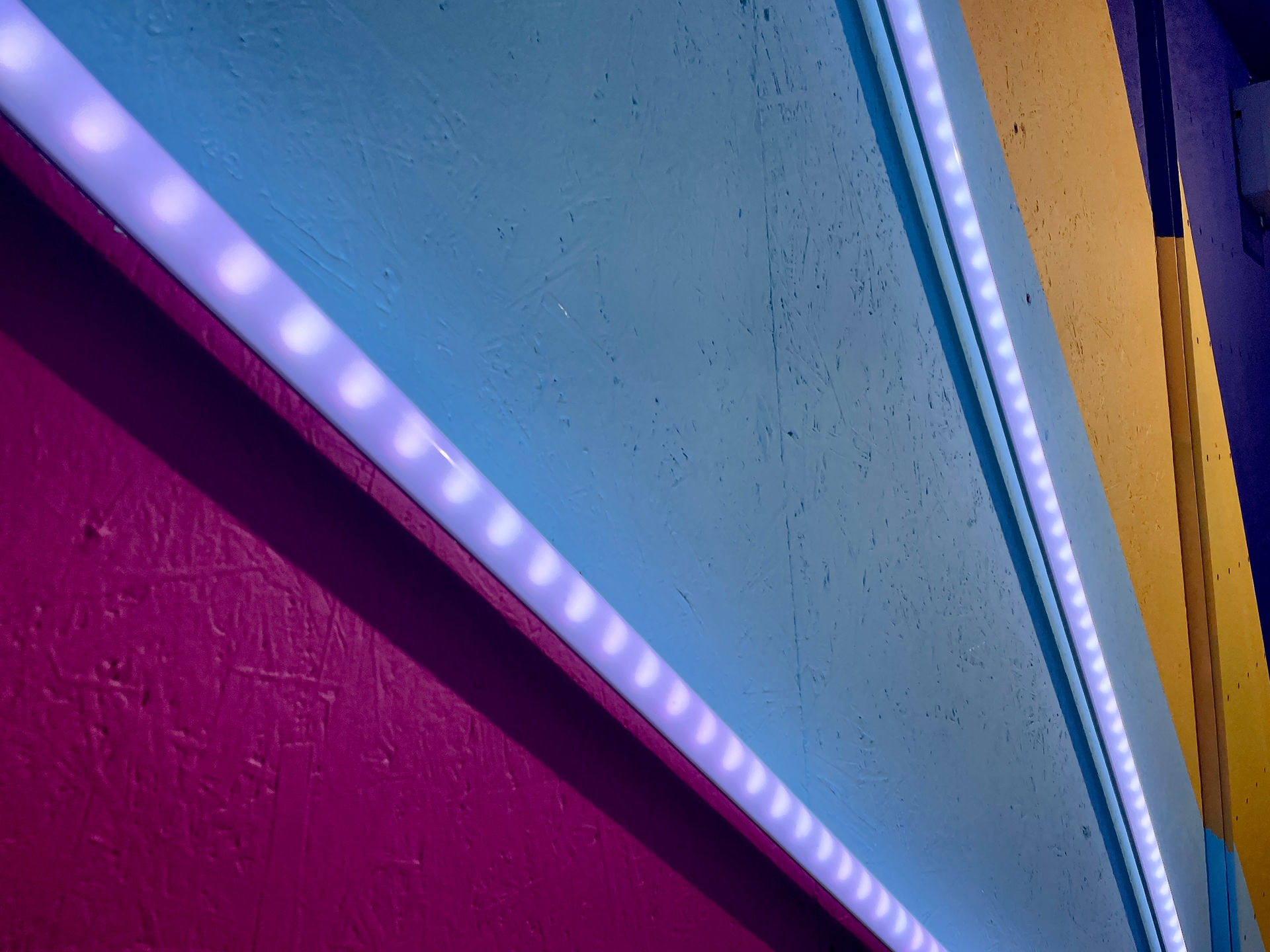
As luck would have it, the person I share my studio with is an electronic genius. Among his many talents, Rob Handyside has designed and built his own programmable LED pixel batons. Lighting was not part of the original plan for this piece. But once I gained full access to the space, it became clear that this was an opportunity to collaborate in a way I had not before. I began experimenting with placement and considering how light could interact with the painted forms.
installing the led control testing install led pixel tubes
I had wanted to incorporate lighting into my work for some time, ever since my Punk’s Not Dead exhibition a few years ago. This felt like the right moment to explore that idea properly. The addition of light added another layer to the work, changing how the shapes were read and how the space was experienced.
On the day I painted it, I used my design as a loose guide and allowed myself to freestyle the rest. I trusted my instinct and let the shapes respond to the space as the piece developed.
Sometimes stepping back, quite literally, is what it takes to see things clearly.
Looking back, this project feels like a turning point. It brought together instinct, inspiration, experimentation, and structure in a way that finally clicked. It connects many parts of my creative journey, from those early dreams to my ongoing fascination with architecture, shape, and scale.
At dbase studio, we are interested in the moments where design becomes experience. Where a piece does not just exist in a place, but actively shapes how people move through it and how they feel as they enter a space. This mural became exactly that, a transition from outside to inside, from street to interior, from one state of mind to another.
Scroll through the photos below to see how the project came together, from concept and experimentation to the finished installation.
to see more of Robs work, head to: Eventresearch.io


Comments